More and more children in WV are going without health insurance

By Michael Griffith

West Virginia ranked fourth-best in the nation in 2016 for providing health care insurance to its children. But in 2018, that ranking dropped to 14th.

Picture from Public News Service

According to a report by the Georgetown University Center for Children and Families, for the first time in a long time, the number of uninsured children has risen in West Virginia and the country overall. In fact, this was the first time ever that no state had shown an increase in the number of uninsured children. In 2017, the number increased by over 250,000 in America. While WV’s numbers aren’t as high as other states, this is just another thing negatively affecting the children of WV and their well-being. 

Health insurance coverage is very important for children by providing access to basic health needs. Routine checkups, medication, and better access to a usual source of care. Not to mention, an uninsured child could mean medical debt for a parent or family. If an uninsured child falls on the playground and breaks an arm at school, their parents are going to be in for a rude awakening when it comes to the hospital bill.

According to an article by Diane Bernard of WV Public News Service, the same report finds that about 4,000 more children are uninsured compared to only two years ago. This is also despite WV leaders adopting Medicaid in 2014. While the country as a whole had an increase of about 400,000 children who became uninsured between 2016 and 2018, bringing the total in America to over 4 million, WV’s numbers have continued to fall.

WVCHIP was introduced in 1997 and is helping to combat the number of children who are uninsured.

CHIP did announce their new maternity services for new mother’s and their newborns. earlier this month.

Although 52 percent of U.S. children are covered by private insurance plans, 43 percent are covered by government-sponsored services, with Medicaid and CHIP being the highest. While in West Virginia around 49 percent of children are insured by government programs. 42 percent of these children are insured by Medicaid and CHIP.


Changing Leaves Are Helping a Changing Tourism Industry in WV

By: Emmy Rinehart

West Virginia needs money, and they may soon lose a big source of income due to the push for renewable energy moving away from coal

Tourism in WV is using the fall foliage as a way to increase revenue for the state by drawing people in with the breathtaking WV landscapes that are painted in astonishing warm hues during the fall season. 

The WV tourism industry is rebranding the state to focus on all the ways to enjoy the natural beauty that is so present here. According to a recent study done by a leading national firm for tourism economic research, the state has seen a 6.5% growth in the tourism industry in 2018, which made the industry worth soar to $4.55 billion. This growth is something Jim Justice has championed during his time in office. 

One neat way WV Tourism and Forestry has worked to bring in more tourism in the fall is with a leaf color tracking map where people can tweet their photos of WV foliage with the hashtag “AlmostHeaven”. Some of these photos are picked to be featured on the WV Tourism and Forestry page on the map with descriptions of the location and what you can do there. 

Although this year is supposed to be a bad year for fall foliage in the south because of the drought making leaves immediately turn brown, the north is still seeing great color even though the changing of the leaves was late this season.

WV Tourism also offers a Fall Inspiration Guide of must-see stops, travel tips and hidden gems in WV in the fall that are more beautiful during this time of year to encourage people to visit now. The site also offers suggestions of routes to drive to experience the fall foliage at various elevations that provide the best road-trip views.

You can follow pictures of the fall foliage with the hashtag #AlmostHeaven on Twitter and Instagram. 

The state is learning to embrace it’s unique and beautiful landscapes as a source of revenue within the tourism department, and by the views they share on their website and all of the amazing things you can do in WV, it sure looks like #AlmostHeaven.

Justice and other large-acre farms receive large sums under “Trade War Bail-out”

by Ciara Litchfield

A farm linked to Jim Justice recently received the maximum amount from a subsidy meant for the farmers in North Carolina that were struggling due to the trade war with China.

Jim Justicehttps://de.wikipedia.org/wiki/Jim_Justice

One would think that a subsidy meant for the “average American farmer” struggling financially, would not apply to the farms that are owned by the richest man in the state of West Virginia. Justice has a net-worth of $1.5 billion and is the state’s only billionaire.

 However, it turns out that the aid is offered per acre which allows the larger farms to collect more in aid than smaller farms. This aid also doesn’t require farms to prove losses, just their production.

The farm linked to Justice received $121,398 for soybeans and $3,602 for corn when the median for amount received is $6,438 for soybeans and $152 for corn. This farm is part of an ongoing lawsuit that alleges the Justice businesses transferred assets between them in an effort to avoid paying a debt.

These tariffs majorly impacted farmers who make a living off of soybeans and other row crops, pork, dairy, cherries, and almonds. The worst blow for the farmers was from the trade war with China was in August when China’s Commerce Ministry halted all agricultural purchases within the United States.

This comes as the Farm Bureau revealed that farm Chapter 12 bankruptcies were a total of 580 filings and the highest since 2011. These bankruptcies are a combination of the tariffs imposed by China as a result of tariffs placed on them and two consecutive years of adverse planting, growing and harvesting conditions. 

“We had such a wet spring that most people weren’t able to get their crops into the ground until really, really late — sometimes not even until June,” Sarah Zastrow a farmer in Michigan said about the planting season. “It rained a ton this spring and then stopped, and we didn’t get very much rain all summer long, so not only were the crops behind because the spring rain pushed them back, but when they did get in the ground, there wasn’t the rain to help them grow.”

Not only are farmers facing economic adversity, but the farming equipment suppliers are facing layoffs. Both Deere & Co. and Caterpillar lowered their sale outlook for 2019 due to the trade war and little demand. Deere & Co. laid off a total of 160 works in Illinois and Iowa while Caterpillar laid off 120 workers in Texas.

edited on Wednesday, November 20th at 4:18 to add a byline and fix two links.

The decrease in West Virginia’s population could be a significant problem

By: Jared Jorden

The long-term view says our state has lost 48,000 people since the 2010 census, and unless something changes, the population will only get lower.

A loss of 48,000 isn’t too significant out of the 1.8 million population. But compared to the nation’s population growing by 26 million, it’s a big drawback. This means that West Virginia struggles to attract and retain people. The most recent population estimates in the state are from July 2018. The actual 2020 numbers that come out will be more important and accurate, but the estimates give us an idea where we’re heading.

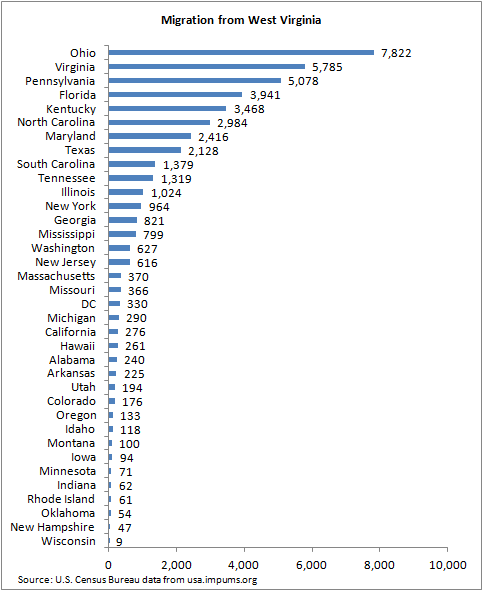
The direction we’re heading is not good. West Virginia has two problems that stick out to me. The first problem is that more people are moving out of the state than moving in. This is an issue that isn’t unique to West Virginia, at least 15 other states have had the same problem. The poor job market is often cited for a reason why people leave the state.

The other problem is West Virginians are dying faster than they are reproducing. 18% of our population is over 65 years old, which is the third highest in the nation. We’re also one of two states that has seen more deaths than births in the past 10 years. The other state is Maine, but they have significantly more migration than West Virginia, so it’s not a problem for them. West Virginia has lost roughly 30,000 to migration and it has about 20,000 more deaths than births.

out

The population number in West Virginia could be looked at as an asset or a liability. The state isn’t taking on too many people to support, but our economy isn’t strong enough to support people financially.

The biggest impact in my opinion will be on the state’s national representation. If we continue this declining population, West Virginia will lose one of its three seats in the House of Representatives in the 2022 election. Which in turn means we will have one fewer electoral vote for the 2024 presidential election.

In the 1930s and 40s West Virginia had six seats in the house while Florida only had five. Florida now has 27 and will probably gain more after the 2020 census. Florida had gained more people through migration (2.2 million) in the past 10 years than West Virginia has in population (1.8 million).

The politics of it is worrisome for our state, but the economy is the most important thing we should focus on to strive for a prosperous future.

Trouble For West Virginia As Murray Energy Files Bankrupcy

By: Alayna Degenhardt

Murray Energy, the largest privately owned coal company in the US, chose to file for bankruptcy on October 29. The company has many operations across the United States and roughly 3,000 employees in West Virginia.

Murray Energy Files for chapter 11 bankrupcy

The Founder of Murray Energy, Bob Murray, has stepped down as CEO and now only holds a place on the board. What does the bankruptcy of Murray Energy mean to West Virginians?

West Virginia government officials voiced their concern with the news of Murray Energy. Senator Shelly Moore Capito said on Metronews, “The bankruptcy with Murray is a tragedy for our state.” The court showed Murray Energy as being $2.7 billion dollars in debt. 

Murray Energy plays a big role in West Virginia’s economy and employment. Yearly, Murray Energy produces 76 million tons of coal. They also employee roughly 7,000 people, and  plan to stay in operation under the Chapter 11 bankruptcy. Murray Energy has roughly $350 million dollars of cash on hand from a lending group to help them get through this time. 

Senator Joe Manchin and the United Mine Workers of West Virginia continue to voice their concerns with the bankruptcy. They claim it will directly affect their pensions and benefits. 

United Mine Workers President Cecil Roberts said, “Now comes the part where workers and their families pay the price for corporate decision-making and governmental actions. Murray will file a motion in bankruptcy court to throw out its collective bargaining agreement with the union.”

Senator Manchin has been pushing Congress for years for federal support for a national pension plan for miners. Senator Joe Manchin is past years use to auto tweet every morning, “support the miners pension!”

Other West Virginia residents have made comments saying “this will be the death for West Virginia,” and it could possibly if Murray Energy can’t get back on their feet. Miners could leave the state to find jobs elsewhere, and West Virginia’s economy could fall without the support of Murray.

The natural tourist attraction that helps keep West Virginia afloat

By Michael Griffith

There aren’t many places better for whitewater rafting than the rivers of West Virginia. Not only does this thrilling adventure bring money into the state, but it also allows people from the entire world to experience the natural beauty of West Virginia.

WV Senator Joe Manchin’s personal Twitter

With more than 50,000 new rafters visiting West Virginia every rafting season, it’s no question that the rivers of WV are one of the top reasons people visit. 

250,646 thrill-seeking customers were guided down West Virginia’s five commercially run rivers in 1996. That number had decreased by almost 50,000 people by 2006, with the decline becoming more steady throughout the years. 150,00 in 2012, 140,000 in 2014, and then only 130,000 paying customers the year after that. 

Now, after a 15-year decline of customers, West Virginia rafting companies are experiencing an upswing in numbers. This increase followed a season that brought the number of rafters to the state’s rivers to its lowest ever. According to Rick Steelhammer of the Charleston Gazette-Mail, a total of 134,082 people paid to take trips down the Cheat, Gauley, New, Shenandoah, and Tygart rivers last year. A number up by 3,870 from the year prior.

Along with bringing people to the Mountain State, commercial rafting brings a great deal of money in as well. For anyone on campus looking for a way to try rafting for the first time, or just go again, the Adventure WV office located in the Student Rec Center at WVU helps students go on rafting trips. Check them out here.

Planetware.com recommends where to go rafting in West Virginia as well as a description of what each river brings to the customers, respectively, for anyone looking to go rafting. You should try it if you’ve never been, it’s awesome.

West Virginia has Failed Its Foster Children and It’s Time That Changes

By Emmy Rinehart

On Monday, September 30, a 105 page complaint was filed on WV’s foster care system, resulting in a federal lawsuit. The complaint describes stories of neglect of foster children under the department’s care for being placed in inadequate and dangerous homes, left without needed services and some were even forced to remain in foster care for years when they otherwise may not have been in the system for as long. 

One story includes a 17-year-old boy who was physically abused by his family and had been under the care of the WV Department of Health and Human Resources (DHHR) since 2012. He lived in group homes and residential care centers and then was sent to a juvenile detention center to sleep in a locked cell on a mattress on a cement floor. He has attempted suicide several times and suffers from depression. When he turns 18 and ages out of the system, he will be homeless with no resources. 

Stories like this are heart-wrenching, and yet, there are so many just like it from other children within the state. In September, lawmakers even stated 651 children in foster care in the state have run away from group homes or schools in the last year. With the issue of the over-institutionalization of kids with emotional and behavioral disorders that the state has already addressed. Twitter has sounded off on this issue as well. 

The complaint was filed by a Charleston law firm alongside nonprofit advocacy groups, A Better Childhood and Disability Rights West Virginia. They filed the lawsuit because they say that there are significant administrative issues that are preventing the system from doing its crucial job: protecting WV’s youth within the foster care system.

The issue doesn’t end here though. Not only is WV’s foster care system failing to give these children the resources they so desperately need, they have also failed to maintain enough foster homes to safely place children where they will be able to thrive. This has led hasty placements being made with relatives without ensuring that the child will be safe in these situations.

A solution is starting to take form, however, on this extremely sad issue. On October 31, the DHHR appointed Pamela M. Woodman-Kaehler as the first foster care ombudsman in the state. She will be required to advocate for the rights of foster children and parents, as well as participate in investigations of complaints of inaction/questionable actions made by social service agencies and managed care services, create and maintain a system for gathering and analyzing data from these complaints across the state and watch for changes in foster care regulations at local, state and federal levels. 

This development means that privatized entities are being brought into the WV foster care system, but it seems to be a step in the right direction for a program that has been neglected for so many years. Over 40 other states also have managed care organizations overseeing their foster care systems. With the opioid crisis that has ravaged the state in every way possible and only added to the demand placed on the foster care system, an immediate effort for change was needed. 

WV’s children deserve more. They are the future of the state, and they desperately need the resources necessary to live happy and healthy lives. WV needs them to be a part of the change within the state, but they have to be the change for them first.

WVU and CDC Partner to Promote Healthy Lifestyles

by Ciara Litchfield

West Virginia University has recently partnered with the Center for Disease Control and Prevention in order to help promote healthy lifestyles in a state that isn’t so healthy compared to others. 

Photo by WVUToday.com

The program, called Be Wild, Be Wonderful, Be Healthy, provides funding for 18 organizations in Clay and McDowell counties that increase access to healthy foods and encourages physical activity. The program leaves much of the planning up to the organizations in order for them to decide what serves their community best and what would be most effective in engaging the community. 

The project coordinator for the program, Kerry Gabbert said that, “We look forward to seeing the unique ways community organizations in Clay and McDowell counties work to create opportunities for their residents to be more active and make healthier food choices. Each community has its own set of challenges, and our contractual partners have creative, strategic plans to move their communities forward and overcome some of those challenges.”

This program hopes to help reduce obesity rates in a state that currently leads the rest of the United States.  Obesity in W.Va. adults stands at 39.5 percent, closely followed by Mississippi, according to a report released by the Trust for America’s Health.

In the counties where this program launched, there aren’t many options for healthy foods. In Clay County, the only grocery store has closed and in McDowell County the only Walmart has left.

Many rural West Virginians don’t live that close to fresh produce and are one of the states least likely to report exercising 3 times a week for at least 30 minutes. 


Some factors that contribute to obesity include lack of regular activity and a healthy diet, genetics, illnesses and medication. Food insecurity is also a major contributor to obesity in West Virginia which means that they worry about having enough money to buy healthy meals. When people stress about money, many often chose low cost options such as fast food because they are easily accessible and low cost in comparison to fresh, healthy produce.

They encourage people to follow the program’s Instagram. Their posts provide followers with helpful tips to stay active and healthy recipes that are easy to follow.

Where is the money for West Virginia?

By: Jared Jorden

Air Pollution, Backlit, Coal, Dawn, Dusk

Under the 2017 deal between the United States and China, China’s largest energy company would spend nearly $84 billion in West Virginia over the next 20 years to build facilities that extract natural gas to generate power.

It sounds too good to be true. The potential value of the China Energy deal is greater than everything the state of West Virginia produces in a year. In the previous years our state budget was only $4 billion.

In celebrating the announcement, West Virginia officials promised that these projects would be underway within a year. “This time next year, you will see construction activity taking place,” the state’s former Commerce secretary, Woody Thrasher, told reporters on Nov. 13, 2017. A month later, Gov. Jim Justice confirmed that timeline. “It would not surprise me, within my 10-month window of today, to see shovels in the ground,” Justice told a town hall on WSAZ television.

However, there was skepticism from Senator Manchin about the deal that surfaced almost immediately, and for good reason. Officials talked about the general areas where China Energy would invest but didn’t provide a detailed list of projects or an accompanying timeline. The details of the plan have never been make public.

Lawyers have gotten involved to see if this money will actually turn up. Appalachian Mountain Advocates filed a brief with the state Supreme Court in June, requesting a Freedom of Information Act request aimed at finding out more about the deal.

It’s now two years later and the $84 billion seems to have been an empty promise for West Virginia.

Guess Who’s Back. Elk Are Back!

By: Alayna Degenhardt

Most people who reside in West Virginia, are probably not aware that the state has begun to repopulate it’s grounds with Elk. The elk came over from Land Between The Lakes in Kentucky and from Arizona. 

The repopulation of Elk could bring more tourism to the state. Especially, in areas that don’t get a lot of tourism, and you know what that means. If more people are coming to the state, that means we may see a rise in our economy. 

Photo by Josh Meeder on Pexels.com

In the beginning, the elk were being held in Logan County’s Tomblin Wildlife Management, and they are certified disease free, so no worries about West Virginia trying to repopulate something that carries a harmful sickness. 

The current Elk population in West Virginia is over 80, but bringing in more Elk this year has stopped due to not being able to obtain any from other states. 

The original plan for the Elk repopulation was that at the beginning of every year, West Virginia was suppose to see Elk brought in, but that wasn’t the case this year. The Land Between The Lakes is currently trying to get their own population back-up, and the Arizona Game and Fishing Commision saw complaints from licences owners for the decrease in Elk population in their state. 

Arizona Elk head to the WV mountains

Both Kentucky and Arizona seem to be rebuilding at the moment, but West Virginia plans to see more elk in 2020. 

Former West Virginia DNR Director Frank Jezioro spoke on this issue.  “We’re definitely looking to bring in another 75 to 100 and hopefully we get that done in 2020 and 2021.” he said. “However, we have to be very careful with where we get the animals. There’s very few states where we can bring animals in due to health and disease concerns. We definitely want to be very careful with it.”

Maybe you’re wondering why would West Virginia want to bring back Elk and what would it do for us? There’s actually a lot of reasons. 

Matt Pedigo from the Michigan Wildlife Council made a good point about hunting too. “There is far more to hunting than chasing after white-tailed deer,” he said. “What many people don’t realize is how critical hunting and fishing are to maintaining the forests, waters and wildlife that everyone in the state can enjoy.”

So if you happen to find yourself driving down West Virginia back roads, make sure you look out for our new residents.